

After topping it for two consecutive years, Gujarat slipped three places on the NITI Aayog's Export Preparedness Index (EPI) for 2022, as Tamil Nadu emerged as the most export-ready state, the central think tank said in its report released on Monday. In a continuing trend, coastal states were found to have the most robust export infrastructure, which officials attributed to the integration of maritime trade into the core of their economies. Maharashtra and Karnataka retained their positions -- second and third, respectively; Haryana was ranked first among landlocked states and fifth overall.

The size of India's middle class will nearly double to 61 per cent of its total population by 2047, from 31 per cent in 2020-21, as continuing political stability and economic reforms with a sustained annual growth rate of between 6 per cent and 7 per cent over the next two and half decades will make the country one of the largest markets in the world. The findings are part of a report released on Wednesday by the People Research on India's Consumer Economy (PRICE) and India's Citizen Environment, a not-for-profit think tank. The report titled, The Rise of India's Middle Class, is based on an analysis of primary data collected by PRICE through its pan-Indian survey.

India, along with Southeast Asian countries such as Indonesia, is expected to sustain growth in the medium-term in Asia region, replacing China as the key growth driver, Morgan Stanley and Nomura said in two separate reports released on Monday. While Morgan Stanley projected a 6.2 per cent gross domestic product (GDP) growth forecast for India in FY24, Nomura estimated the Indian economy to grow at 5.9 per cent in 2023. "Even with a slowing China, we expect GDP growth in Asia to sustainably outperform other emerging markets and the US. India and Southeast Asia are set to be the fastest-growing economies this decade.

India's urban unemployment rate declined in Q4FY23 to 6.8 per cent - the lowest in over four years -- after it stagnated at 7.2 per cent in the previous October-December quarter, reflecting improvement in the labour market, according to the Periodic Labour Force Survey (PLFS) released by the National Statistical Office (NSO) on Monday. The unemployment rate in current weekly status (CWS) terms for all ages in the March quarter was the lowest recorded in more than four years, from the time the NSO released India's first quarterly urban jobless rate for the December quarter in 2018. The jobless rate in urban areas had been on a continuous decline since the peak of 20.8 per cent in the April-June quarter of FY21.
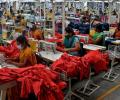
The share of women workers in registered factories submitting annual returns - working more than the statutorily-mandated maximum limit of 48 hours in a week - increased to a 11-year high of 33.6 per cent in 2019, shows the latest annual data released by the labour bureau. In comparison, only 27.9 per cent male workers worked more than the statutorily-mandated hours. Earlier in 2008, 39.2 per cent women workers had worked more than the prescribed work time.

The churn in Indian labour markets will be led by technology-driven sectors like artificial intelligence and machine learning (38 per cent), followed by data analysts and scientists (33 per cent) and data entry clerks (32 per cent).

Only one in four workers in Karnataka receive a salary, the lowest among the four industrialised states of India, a Business Standard analysis of the latest annual Periodic Labour Force Survey (PLFS) data shows. While 31.6 per cent workers in Gujarat receive regular wages (or salaries), followed by Tamil Nadu (30.3 per cent) and Maharashtra (29.4 per cent), only 25.7 per cent workers in Karnataka receive the same. The figure stands at 21.5 per cent at the national level, according to the 2021-22 PLFS data.

If you have seen Zwigato, Param Kumar's story will sound familiar. Laid off from his job as a repairman at a Gurugram-based water purifier provider, he now delivers groceries and food for a mobile-based delivery app, in Delhi. Kumar, who started making deliveries last August, told Business Standard that he is working longer hours than his older salaried job as an RO repairman, and has no paid leaves or health insurance. Kumar is part of India's estimated 7.7 million-strong force of gig workers.

A decision on the interest rate for close to 60 million active subscribers of the Employee Provident Fund Organisation (EPFO) is likely to be taken in the next Central Board of Trustee (CBT) meeting, starting on March 25. A letter from the social security organisation regarding the convening of the 233rd CBT meeting was sent to all the board members last week, soliciting their presence in the meeting. Although the venue and the agenda haven't been drawn out yet, sources familiar with the matter say that the interest rate is unlikely to go below 8 per cent level amid a rising interest rate scenario across the globe.

In the jobs created in 2022, the share of those in the age group 18-25 increased to at least a five-year high of 56 per cent. A Business Standard analysis of the monthly Employees' Provident Fund Organisation (EPFO) payroll data shows in 2018 the share of youths among the new EPFO subscribers was 50.9 per cent. The National Statistical Office is releasing the monthly EPFO payroll data since April 2018 as part of the government's effort to track formal-sector employment by using payrolls as an instrument.

India is expected to contribute 15 per cent to the global growth in 2023, an International Monetary Fund (IMF) official said on Tuesday. "Both India and China are expected to contribute 50 per cent of the global growth in the upcoming year (2023). "However, the share of India's contribution to global growth is expected to be around 15 per cent," Krishna Srinivasan, director, Asia and Pacific Department (APD) at IMF said at a roundtable with reporters from south Asian countries.

With organisations like the Bharatiya Mazdoor Sangh, which is a front of the Rashtriya Swayamsevak Sangh, telling Finance Minister Nirmala Sitharaman they want OPS back, the government is in a bind, report Shiva Rajora and Aditi Phadnis.

The central government is likely to further consolidate its fiscal deficit by 50 basis points (bps) to 5.9 per cent in FY24 from 6.4 per cent in FY23, according to a recent report released by Goldman Sachs on Tuesday. In the current fiscal year, there is going to be an upside of 0.5 per cent on the receipts side due to higher nominal GDP growth, and higher tax buoyancy because of the formalisation, the report said. The upside to expenditure is mainly going to come from incremental subsidies (0.8 per cent of GDP), in both food and fertilizer, it said. The upcoming pre-election Budget will carry forward the trend of the increased capital expenditure seen in recent years.

India has been relatively insulated from the severe headwinds in the West. However, with a third of the global economy expected to slip into recession in calendar year 2023, the impact will strongly be felt on India's exports and trade economy, leading economists said in a panel discussion at the Business Standard BFSI Insight Summit in Mumbai on Wednesday. The panel comprised former Reserve Bank of India executive director and former Monetary Policy Committee member Mridul Saggar, State Bank of India Chief Economic Advisor Soumya Kanti Ghosh, Citibank India Chief Economist Samiran Chakraborty, ICRA Chief Economist Aditi Nayar, and IndusInd Bank Chief Economist Gaurav Kapoor. The topic of the panel discussion was No recession in sight: Is India decoupled from developed economies?

Six states out of 22 major states and Union Territories (UTs) generated fewer formal jobs for the youth in the September quarter than they did in the corresponding quarter a year ago, a Business Standard analysis of the data released by the Employees Provident Fund Organisation (EPFO) shows. States like Punjab (-12.4 per cent), Himachal Pradesh (-10.3 per cent), Jharkhand (- 7.2 per cent), Assam (-3.7 per cent), Gujarat (-3.4 per cent) and Rajasthan (-.1.1 per cent) saw further decline in the number of net new subscribers in the second quarter (Q2) of FY23 compared to the last year. The analysis did not include northeastern states, except for Assam. This is crucial as the subscribers in the 18-28 age group are seen as first-timers in the labour market, thus reflecting the robustness of the job market.

The law firms will provide legal opinion on matters related to interpretation of various statutes, such as the Employees' Provident Funds and Miscellaneous Provisions Act, 1952, among other things.

A government ministry has proposed decriminalising offences under the Collection of Statistics Act 2008 as part of the government's efforts to rationalise legislations to promote the ease of doing business. The Ministry of Statistics and Programme Implementation (MoSPI) has invited public comments on its draft proposal by October 30. The proposal to amend sections of the act will decriminalise offences like obstructing or deceiving statistics officers by doing away with the provision of simple imprisonment up to six months.

India has the best hiring outlook globally, second only to Brazil, with 54 per cent of companies surveyed planning to hire in the December quarter as against 51 per cent in the September quarter, according to a report by global staffing firm ManpowerGroup. The report titled "ManpowerGroup Employment Outlook Survey" showed that India has the strongest net employment outlook for the December quarter in the Asia-Pacific region, followed by China (46 per cent), and Australia (38 per cent). The global net employment outlook in the December quarter would stand at 30 per cent, down by three percentage points from the June-September quarter, yet six percentage points higher than the same period last year, the staffing firm said.
